

Last Friday, an unprecedented power outage affected approximately one million people in the Czech Republic. The causes are gradually being revealed and are also the subject of political struggle. But let's look at the blackout from a slightly different angle. Specifically, how the event impacted electricity price developments, and also whether it is possible to avoid problems as an individual connection point.
The primary cause of the blackout was a technical defect – the fall of a phase conductor on the V411 transmission line in northwestern Bohemia. This initial failure triggered a cascading failure in the transmission system, leading to the disconnection of the V411 line, the shutdown of the sixth block of the Ledvice power plant, the overload of the V208 line, and the disconnection of the V401 line at the Krasíkov substation. Subsequently, a part of the transmission system was separated, making its operation impossible.
In addition to material damage, the blackout also caused sudden fluctuations in spot energy prices, which, contrary to expectations, fell into negative territory. This was caused by an enormous drop in demand and the resulting surplus of electricity. Spot prices remained in negative territory until the afternoon, when electricity supplies began to be restored.
The blackout, although it caused extreme short-term price anomalies on the spot market, did not fundamentally change the broader, already existing downward trend in overall electricity prices for 2025.
“The long-term market outlook is more influenced by global commodity price trends and proactive regulatory decisions (e.g., investments in grid modernization and integration of renewable sources) than by temporary, albeit serious, operational disruptions,”
What can be done to minimize the impact of a blackout?
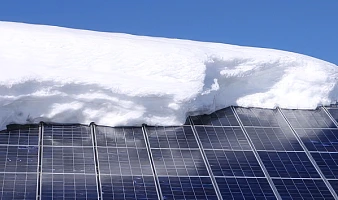
The fact that the transmission system needs gradual modernization is more information for higher authorities. However, households can also prevent unpleasantness. How? First and foremost, photovoltaics offer a solution. However, this answer is too simplistic, because an FVE (photovoltaic system) connected only to the distribution network will shut down itself in case of a failure. In order to be able to draw electricity from an FVE during a blackout, we need a battery storage system and a hybrid inverter that will set the household to the so-called 'island' mode.
It is precisely in 'island' mode that smart energy management can help, efficiently distributing electricity to appliances and batteries. In this mode, the operability of important appliances can be maintained for a longer time. “Smart energy management is part of our tariff Fotonka+. The Hardmin module offers maximum energy distribution efficiency within the household,” Tobiáš adds. Of course, everything also depends on the current weather. In this case, it was ideal, but that may not be the case in other situations.
So, with or without photovoltaics, we may eventually find ourselves at the same starting line. When a failure occurs, let's first check if it's a local, regional, or national problem. Indicators can be street lighting, mobile signal, trolleybus transport. If the problem is on all the mentioned fronts, it is likely a wider outage. To verify the information, a car radio or a battery-powered radio receiver will then serve us well. It is good to have a charged power bank so that we can access the necessary information. A diesel generator or charging station is an expensive and oversized solution.
The risk of a longer-term blackout (in the order of tens of hours) is minimal here. Even in that case, restoration occurred within a few hours. Therefore, it is good to minimize the impacts with a cool head – do not open the refrigerator or freezer, and in winter, for example, prevent the escape of accumulated heat by closing all ventilation openings. We also recommend unplugging appliances from the sockets. Although they have protective features, a sudden restoration of supply can cause irreparable damage in a few cases. The key is therefore to approach a blackout without panic and apocalyptic scenarios.